
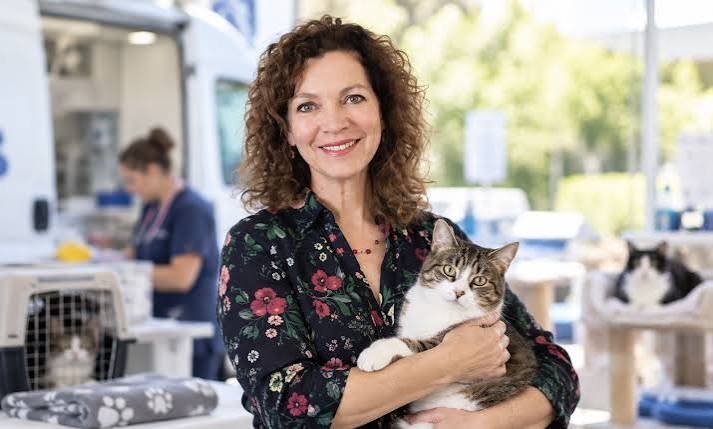

Donna Sicuranza is an American nonprofit executive best known for her long-standing work with Tait’s Every Animal Matters (TEAM), an animal-welfare organization based in Connecticut. Her career is closely connected to the development of a mobile feline spay and neuter clinic designed to make essential veterinary services more accessible to cat owners and caretakers.
TEAM’s official staff directory currently lists her as Donna Sicuranza Marconi, Executive Director. The organization reports that its veterinarians have sterilized and vaccinated more than 225,000 cats since the mobile program began in 1997.
Unlike public figures known primarily for entertainment or social media, Sicuranza’s public profile has developed through nonprofit leadership, community outreach, and sustained animal-welfare work. Her professional history also reflects a long partnership with veterinarian Dr. John A. Caltabiano, whose vision helped shape TEAM’s mobile clinic.
This biography explores Donna Sicuranza’s career, her involvement with TEAM, the history of the mobile clinic, her work in feline population control, and the facts that can be established from available public records.
Donna Sicuranza: Quick Biography
| Detail | Information |
|---|---|
| Name commonly used | Donna Sicuranza |
| Current professional name | Donna Sicuranza Marconi |
| Other name in historical records | Donna J. Sicuranza |
| Profession | Nonprofit executive and animal-welfare advocate |
| Organization | Tait’s Every Animal Matters (TEAM) |
| Current position | Executive Director, according to TEAM |
| Professional location | Connecticut, United States |
| Earlier career | Journalism and public relations, according to published reporting |
| Major initiative | TEAM Mobile Feline Spay/Neuter Clinic |
| Clinic launch | March 1, 1997 |
| Veterinary collaborator | Dr. John A. Caltabiano |
| Organization’s reported impact | More than 225,000 cats sterilized and vaccinated since 1997 |
These details describe her documented professional background. Her exact birth date, age, and personal net worth are not established by the authoritative sources referenced in this article.
Who Is Donna Sicuranza?
Donna Sicuranza is a Connecticut-based nonprofit leader whose public career is associated with feline welfare and access to veterinary care.
She is best known for her work with Tait’s Every Animal Matters, generally referred to as TEAM. The organization operates a mobile feline clinic that travels to communities throughout Connecticut to provide spay, neuter, and vaccination services.
The central idea behind the program is straightforward: preventing unwanted litters can help reduce feline overpopulation, lessen pressure on animal shelters, and improve the welfare of cats living in homes and outdoor colonies.
TEAM’s work includes domestic cats as well as feral cats. This broad focus matters because free-roaming cats can be difficult to manage through conventional veterinary arrangements, particularly when caretakers are responsible for multiple animals.
Sicuranza’s role has been primarily administrative and organizational rather than clinical. TEAM identifies her as its executive director and lists its medical director and veterinary technicians separately.
Her public career is therefore best understood through the organization she has helped lead and the continued operation of its mobile veterinary program.
What Is Tait’s Every Animal Matters (TEAM)?
Tait’s Every Animal Matters is a Connecticut animal-welfare organization focused on reducing feline overpopulation through accessible veterinary services.
Its best-known initiative is the TEAM Mobile Feline Spay/Neuter Clinic. Rather than requiring every client to travel to a permanent veterinary facility, the mobile service brings care closer to participating communities.
According to TEAM’s official website, the program serves domestic and feral cats across Connecticut.
The organization concentrates on several practical needs:
- Spaying and neutering cats to prevent unwanted litters.
- Providing vaccinations as part of its veterinary services.
- Helping people caring for multiple cats access appropriate treatment.
- Supporting efforts to manage feral-cat colonies.
- Maintaining a mobile service that reaches communities throughout the state.
These services address a problem that extends beyond individual pet ownership. When cats reproduce without adequate intervention, communities can face growing numbers of kittens, increased demand for shelter space, and challenges providing food and medical care to outdoor colonies.
TEAM’s model focuses on prevention. By making sterilization services available before cats reproduce, the organization aims to address one of the underlying causes of feline overpopulation.
This mission provides the context for understanding Sicuranza’s professional contribution.
Donna Sicuranza’s Early Career in Journalism and Public Relations
Before becoming closely associated with animal-welfare leadership, Donna Sicuranza worked in journalism and public relations, according to reporting in Connecticut Magazine.
Although the available public record does not provide a complete account of her early employment or educational history, her communications background offers useful context for understanding her subsequent work.
A nonprofit organization needs more than technical expertise to deliver services consistently. It also needs to communicate its mission, explain its programs, respond to public enquiries, coordinate with supporters, and build awareness of the problems it seeks to address.
Sicuranza’s later work with TEAM included public-facing communication and organizational publications. Historical material identifies her as a TEAM spokesperson, while the organization’s 2019 publication credited her as editor of its TEAMWORKS newsletter.
These responsibilities demonstrate a connection between her earlier communications experience and her later nonprofit leadership.
Rather than being entirely separate professional chapters, journalism, public relations, and organizational communication appear to have remained relevant to her work in animal welfare.
How Donna Sicuranza Became Involved With TEAM
The history of TEAM is closely associated with veterinarian Dr. John A. Caltabiano and the need for more effective solutions to unwanted cats and kittens in Connecticut.
Caltabiano had previously been involved in an animal-adoption initiative. According to published accounts, funding difficulties eventually brought that effort to an end.
A later bequest from the estate of businessman and animal lover Vernon A. Tait helped provide an opportunity to continue animal-welfare work.
The challenge was identifying which service would address the needs of local communities most effectively.
A toll-free telephone line allowed people to contact the organization with animal-related concerns. The calls highlighted a recurring problem: unwanted litters, large numbers of cats, and difficulties managing free-roaming and feral populations.
Finding homes for individual kittens could help, but it did not necessarily prevent further litters from appearing.
The problem suggested a different approach. Instead of focusing exclusively on placing animals after their birth, the organization could concentrate on preventing unwanted reproduction.
That approach became central to TEAM’s mobile feline spay and neuter program.
Sicuranza’s involvement in this development helped establish the foundation of a professional career that would remain connected to the organization for decades.
The TEAM Mobile Clinic: From Planning to Launch
Planning for TEAM’s mobile feline spay and neuter clinic began in 1996. The clinic officially went on the road on March 1, 1997.
TEAM’s historical account identifies Dr. John A. Caltabiano and executive director Donna Sicuranza among the people responsible for developing the program.
The concept addressed a practical barrier to veterinary care: access.
A fixed clinic can provide valuable services, but reaching it may be difficult for people living far away, caring for several cats, or managing outdoor colonies. A mobile service offers a different arrangement by bringing veterinary care into participating communities.
The original clinic was a modest operation compared with the service TEAM runs today. Historical accounts describe an early vehicle measuring approximately 22 feet, with limited space for staff and animals.
TEAM’s official history records that ten cats were spayed or neutered and vaccinated on the first day of operation.
Other accounts describe 12 cats treated on the first day. Because published sources differ on the exact initial number, it is more accurate to describe the launch as a small-scale operation rather than present either figure as universally agreed upon.
What is clear is that the clinic began with a limited capacity and grew substantially over the following years.
The mobile model gave TEAM a way to provide targeted veterinary services across Connecticut while keeping its central mission consistent: prevent feline overpopulation and improve access to care.
How TEAM Grew From a Small Clinic Into a Long-Running Program
The expansion of TEAM’s mobile clinic provides one of the clearest measures of the organization’s development.
In its early years, the program established a service that could travel to communities and treat cats that might otherwise have limited access to affordable sterilization.
By 2001, reporting in The Middletown Press stated that TEAM had sterilized more than 40,000 cats since the clinic began operating in 1997.
The same period saw the organization working with both household pets and feral colonies. Historical reporting indicated that a substantial portion of the cats treated came from feral populations.
The program’s growth continued after its first four years.
In November 2009, Dr. Caltabiano died following an illness. His obituary recorded that TEAM had sterilized more than 128,000 cats by that point.
The organization subsequently reached another significant milestone. In February 2019, TEAM performed its 200,000th sterilization procedure on a cat named Calypso in Torrington, Connecticut.
TEAM’s historical account describes the expansion of its mobile service, including the use of purpose-built vehicles and visits to communities across the state.
The organization’s current website reports that its veterinarians have sterilized and vaccinated more than 225,000 cats since 1997.
These figures illustrate the scale of the program over time:
- 1997: The mobile clinic begins operating.
- 2001: Historical reporting records more than 40,000 sterilizations.
- 2009: TEAM has passed 128,000 sterilizations, according to Caltabiano’s obituary.
- 2019: The organization celebrates its 200,000th sterilization procedure.
- Current organizational reporting: TEAM reports more than 225,000 cats sterilized and vaccinated since 1997.
The milestones represent the collective work of the organization, including veterinarians, technicians, administrative staff, donors, and participating communities. They should not be interpreted as procedures personally performed by Sicuranza.
Her significance lies in her long-standing leadership role during the program’s development and continued operation.
Donna Sicuranza’s Work With Feral Cats
Feral cats are an important part of TEAM’s mission because they often live outdoors without a conventional owner or regular access to veterinary care.
Uncontrolled reproduction can cause colonies to grow, increasing the need for food, shelter, and medical attention. Catching and treating individual cats can also be difficult when the animals are wary of people.
One commonly used management approach is Trap-Neuter-Return, or TNR.
Under a TNR program, cats are humanely trapped, sterilized, identified as having received the procedure, and returned to their established outdoor environment. Vaccination and other care may also be provided, depending on the program and the animal’s needs.
TEAM has supported feral-cat assistance through initiatives intended to help people bringing qualifying cats to its mobile clinic.
Its TEAM Incentive Program, known as TIP, was established to assist with qualifying feral-cat services. TEAM’s 2019 newsletter described the program’s development and its role in supporting colony caretakers.
Sicuranza also shared a personal account involving a feral cat she called Sobie. In material published through TEAM, she described trying to trap the cat for neutering before he was killed by a vehicle.
The experience illustrates the practical challenges associated with caring for free-roaming animals. A cat may depend on a person for food and shelter without being easy to approach or capture safely.
The story also provides context for the organization’s work: reducing feline overpopulation is not simply a matter of counting procedures. It involves responding to the needs of animals living in different circumstances.
Also Read: Esha Deol: Biography, Career, Family & Filmography
Donna Sicuranza and Dr. John A. Caltabiano
Dr. John A. Caltabiano was an important figure in Donna Sicuranza’s professional history and in the development of TEAM’s mobile clinic.
As a veterinarian involved in the organization’s leadership, he helped shape its approach to feline population control and veterinary access.
Their collaboration brought together veterinary expertise and nonprofit administration. The clinic required medical personnel to perform procedures, but it also needed organization, scheduling, communication, and a sustainable operating structure.
TEAM’s historical account places both Caltabiano and Sicuranza in the development of the mobile program.
Caltabiano died in November 2009. His obituary identified Donna Sicuranza as his longtime partner and recorded the organization’s substantial sterilization work by the time of his death.
His passing marked an important transition for TEAM. The veterinarian who had helped establish its mobile clinic was no longer there, but the organization continued its work.
Sicuranza remained connected with TEAM’s leadership as the program progressed toward its later milestones.
Their shared history is therefore central to understanding how the clinic began and why the organization’s early development is so closely associated with both names.
Donna Sicuranza’s Family Connection to Animal Welfare
Public records also connect members of the Sicuranza family with TEAM.
An obituary for Robert J. Sicuranza identifies his daughters as Donna J. Sicuranza and Dina M. Sicuranza. It also describes his interest in animals and his involvement with Tait’s Every Animal Matters.
TEAM’s staff information lists Dina Sicuranza as Senior Veterinary Technician.
Historical organizational material also identified Marlene C. Sicuranza in a program-assistant role, illustrating that multiple members of the family have been connected with the organization at different times.
Dina’s long association with TEAM is particularly notable. The organization’s 2019 publication stated that she joined the staff in 1998, shortly after the mobile clinic began operating.
These records show a family connection to the organization’s work, although they do not establish that every member of the family held the same responsibilities or participated in every phase of the program.
For Donna Sicuranza’s biography, the relevant point is that TEAM’s history includes several members of her family, with different roles in administration and veterinary services.
Donna Sicuranza’s Role in Public Communication and Animal-Welfare Policy
Running a nonprofit veterinary program involves more than arranging clinical appointments. Organizations also need to explain their services, communicate with the public, and participate in wider discussions about access to animal care.
Sicuranza’s background in journalism and public relations is relevant to this aspect of her work.
Historical newspaper coverage quoted her discussing TEAM’s clinic and the need for feline sterilization. TEAM publications also credited her with editorial and communications responsibilities.
Her work extended into public-policy discussions as well.
Connecticut Department of Agriculture records identify Sicuranza as a representative of Tait’s Every Animal Matters at an Animal Population Control Program Working Group meeting in 2019.
The working group’s discussions included issues related to veterinary reimbursements, program funding, licensing, rising veterinary costs, and administrative systems.
This involvement placed TEAM’s perspective within a broader discussion of animal-population management in Connecticut.
The state’s Animal Population Control Program provides another example of how veterinary access and sterilization services intersect with public policy.
Although nonprofit clinics and government programs have different responsibilities, both can contribute to efforts to improve animal welfare and address population-control challenges.
Sicuranza’s participation in these discussions reflects the representative and administrative dimensions of her position at TEAM.
Also Read: Varun Dhawan Movies: Complete List, Hits, Flops & Upcoming Films (2026)
What Is Donna Sicuranza Doing Today?
TEAM’s official staff directory currently lists Donna Sicuranza Marconi as Executive Director.
The same page identifies Lacey J. Raymond as Program Coordinator, Art Heller, DVM, as Medical Director, and Dina Sicuranza as Senior Veterinary Technician.
TEAM continues to operate its mobile feline clinic and reports that its veterinarians have sterilized and vaccinated more than 225,000 cats since 1997.
The organization also states that it travels to communities throughout Connecticut and welcomes domestic and feral cats from the state.
These official records provide the clearest current information about Sicuranza’s professional position.
They also show continuity between the original mission and the organization’s present-day services. The clinic continues to focus on feline sterilization, vaccination, and access to veterinary care.
For the most up-to-date staff information and service details, readers can consult TEAM’s official staff directory and mobile clinic history.
Donna Sicuranza, Donna J. Sicuranza, and Donna Sicuranza Marconi: Are They the Same Person?
Readers searching for Donna Sicuranza may encounter several variations of the name.
TEAM’s current staff directory uses Donna Sicuranza Marconi. Older organizational material and historical reporting use Donna Sicuranza or Donna J. Sicuranza.
The consistent professional connection is Tait’s Every Animal Matters and its mobile feline clinic.
The difference in names should not automatically be interpreted as evidence of separate professional identities. In this case, TEAM’s current staff listing and its historical records connect the name variations with the organization’s executive leadership.
However, there is an important distinction to make.
A different woman named Donna Marie Sicuranza lived in New York and died in 2017. Her obituary describes employment with Walker Studios and the Bank of New York.
That obituary concerns a different individual from the Connecticut animal-welfare executive listed by TEAM.
When researching people with shared names, it is important to compare organizations, locations, professional roles, and dates instead of combining details simply because the names resemble one another.
For this biography, TEAM’s own records provide the strongest basis for identifying the Donna Sicuranza associated with the mobile clinic.
Why Donna Sicuranza’s Career Matters
Donna Sicuranza’s professional history illustrates the importance of maintaining a focused community service over an extended period.
Feline overpopulation is a recurring problem. A successful intervention cannot necessarily solve it in a single year, because cats continue to reproduce and new animals enter outdoor colonies and households.
TEAM’s mobile clinic addresses this challenge through repeated access to sterilization and vaccination services.
The mobile format also responds to a practical issue: veterinary services are most useful when the people who need them can realistically reach them.
Sicuranza’s career has remained connected to this model from the organization’s early development through its later milestones.
The clinic’s reported impact reflects the combined work of veterinary professionals, administrative staff, supporters, and community members. Its history demonstrates how an initiative that begins on a small scale can become a long-running program when its mission remains clear and its services continue to meet a genuine need.
Her public legacy is therefore closely connected to TEAM’s sustained work rather than to personal publicity or celebrity recognition.
Also Read: Sanjana Ganesan: Age, Husband, Career, Family & Biography (2026)
Conclusion
Donna Sicuranza is best known for her long-standing leadership role with Tait’s Every Animal Matters, the Connecticut organization behind a mobile feline spay and neuter clinic.
Her professional history connects journalism and public relations with nonprofit administration, community outreach, and animal welfare. Working alongside veterinarian Dr. John A. Caltabiano, she helped develop a mobile program that began operating in 1997 and has since grown into a long-running statewide service.
TEAM’s milestones—from its early years to its 200,000th sterilization procedure in 2019 and its current report of more than 225,000 cats sterilized and vaccinated—illustrate the scale of the organization’s collective effort.
Today, TEAM lists Donna Sicuranza Marconi as Executive Director. Her documented career remains closely associated with the organization’s mission to reduce feline overpopulation and make essential veterinary services more accessible.
For readers researching Donna Sicuranza, the most reliable picture comes from her documented professional role, the history of TEAM, and the continued operation of the mobile clinic she helped establish.
Frequently Asked Questions About Donna Sicuranza
1. Who is Donna Sicuranza?
Donna Sicuranza is a Connecticut nonprofit executive and animal-welfare advocate associated with Tait’s Every Animal Matters (TEAM). The organization’s current staff directory lists her as Donna Sicuranza Marconi, Executive Director.
2. What is Donna Sicuranza famous for?
She is best known for her long-standing involvement with TEAM and the development of its mobile feline spay and neuter clinic, which provides veterinary services to cats throughout Connecticut.
3. What does Donna Sicuranza do at TEAM?
She serves as Executive Director, according to TEAM’s official staff directory. Her documented work is associated with nonprofit leadership and organizational administration rather than performing veterinary surgeries.
4. What is Tait’s Every Animal Matters?
Tait’s Every Animal Matters, commonly known as TEAM, is a Connecticut animal-welfare organization that operates a mobile feline clinic providing spay, neuter, and vaccination services.
5. When did Donna Sicuranza help launch the TEAM mobile clinic?
Planning for the clinic began in 1996, and the mobile service began operating on March 1, 1997. TEAM’s historical account identifies Sicuranza and veterinarian Dr. John A. Caltabiano as key figures in its development.
6. Who was Dr. John A. Caltabiano?
Dr. John A. Caltabiano was a veterinarian involved in TEAM’s leadership and the development of its mobile feline clinic. His obituary identified Donna Sicuranza as his longtime partner. He died in November 2009.
7. How many cats has TEAM helped?
TEAM currently reports that its veterinarians have sterilized and vaccinated more than 225,000 cats since the program began in 1997. This is the organization’s cumulative figure, not a count of animals treated personally by Sicuranza.
8. Is Donna Sicuranza still working with TEAM?
TEAM’s official staff directory currently lists Donna Sicuranza Marconi as Executive Director. The organization continues to operate its mobile feline clinic across Connecticut.
9. Is Donna Sicuranza related to Dina Sicuranza?
Yes. Public family records identify Dina M. Sicuranza as Donna J. Sicuranza’s sister. TEAM currently lists Dina Sicuranza as Senior Veterinary Technician.
10. What did Donna Sicuranza do before joining TEAM?
Published reporting in Connecticut Magazine describes her earlier professional background as journalism and public relations. The available sources do not establish a complete employment or educational history.
11. How old is Donna Sicuranza?
Her exact age and date of birth have not been reliably established in the authoritative public sources referenced here. An age should not be estimated without a verified birth date.
12. What is Donna Sicuranza’s net worth?
No reliable public source establishes her personal net worth. Because she is known primarily for nonprofit leadership, online estimates without documented evidence should be treated cautiously.
13. Is Donna Sicuranza Marconi the same person as Donna Sicuranza?
TEAM’s current staff directory uses Donna Sicuranza Marconi, while historical TEAM publications use Donna Sicuranza and Donna J. Sicuranza. The organizational records connect these name variations with TEAM’s executive director.
14. Did Donna Sicuranza die in 2017?
The 2017 obituary sometimes associated with this search concerns a different woman named Donna Marie Sicuranza from New York. TEAM’s current staff directory lists Donna Sicuranza Marconi as its Executive Director.
15. Where can readers find official information about Donna Sicuranza?
The most direct source is TEAM’s official staff directory. Its historical account of the mobile clinic provides additional background on the organization’s mission and development.



[…] Also Read: Donna Sicuranza: Biography, Career, TEAM Leadership, and Animal Welfare […]