









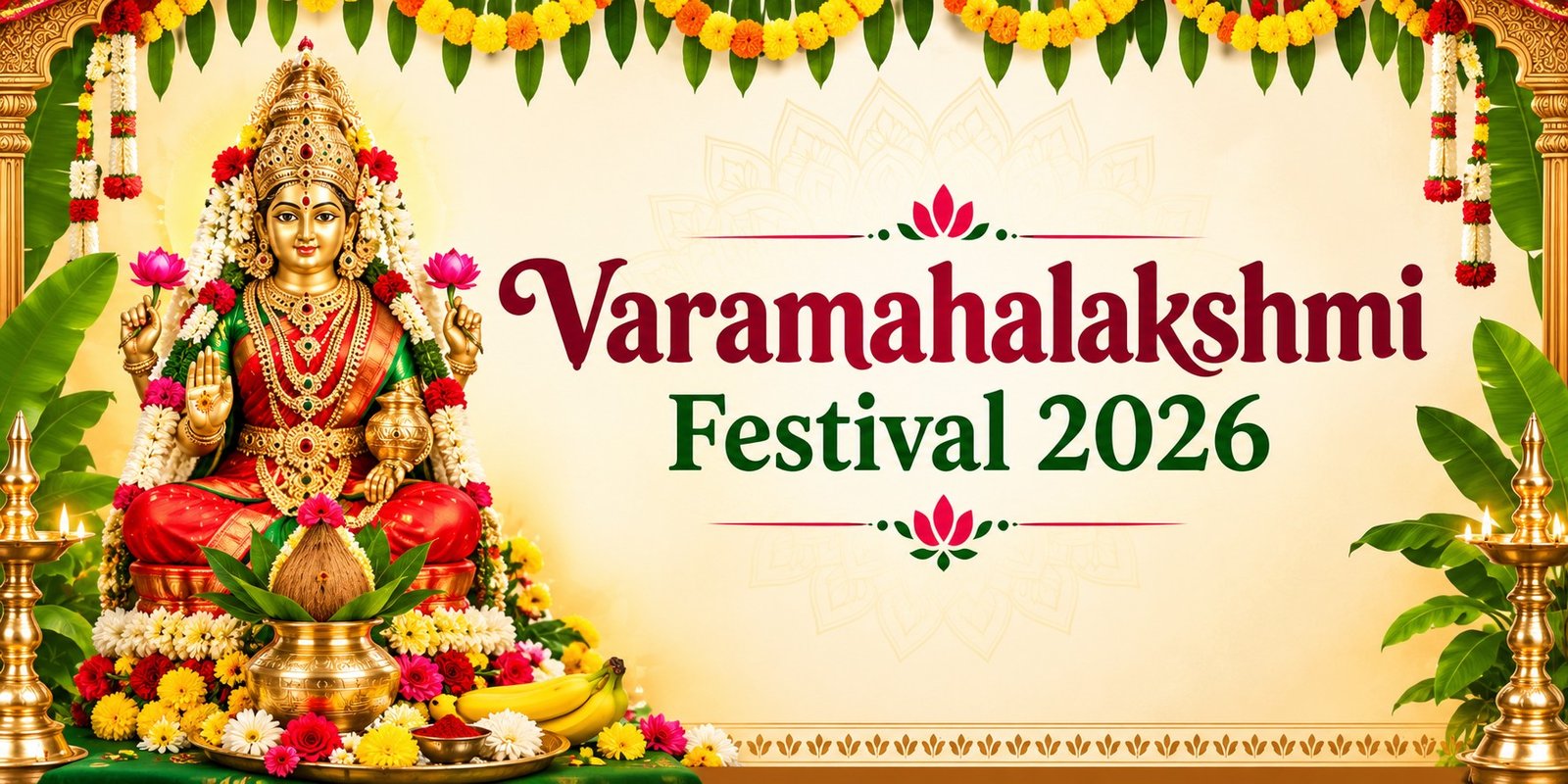
Varamahalakshmi Festival 2026: Quick Answer
| Detail | Information |
|---|---|
| Festival | Varamahalakshmi Habba / Varalakshmi Vratam |
| Date (Karnataka, Andhra, Telangana, Tamil Nadu tradition) | Friday, 21 August 2026 |
| Date (Drik and some North Indian panchangs) | Friday, 28 August 2026 |
| Month | Shravana (Shukla Paksha) |
| Day | Friday |
| Deity | Goddess Varamahalakshmi, the boon-giving form of Lakshmi |
| Main ritual | Kalasha sthapana, dora (sacred thread) puja, bagina to suvasinis |
| Observed by | Mainly married women; unmarried women and men may also join |
Which date should you follow? In Karnataka, most families, temples and Kannada panchangs kept the festival on 21 August 2026. If your family follows a North Indian or Drik panchang, 28 August is the date. Follow the calendar your elders and local temple follow.
What Is the Varamahalakshmi Festival?
Varamahalakshmi is one of the most loved festivals in Karnataka homes. The name has three parts: Vara (boon), Maha (great) and Lakshmi (the Goddess of prosperity). Together it means the great Lakshmi who grants boons.
In Kannada, it is often called Varamahalakshmi Habba. In Andhra Pradesh and Telangana it is known as Varalakshmi Vratam, and in Tamil Nadu as Varalakshmi Nombu. The rituals are similar everywhere, though the decorations, food and customs differ from region to region.
The belief behind the festival is simple. Worshipping Varamahalakshmi on this day is considered equal to worshipping all eight forms of Lakshmi, the Ashtalakshmi, together.
Why Are There Two Dates for Varamahalakshmi 2026?
This question confused many families in 2026, so here is a clear explanation.
The traditional rule says Varamahalakshmi is observed on the Friday just before Shravana Purnima. In 2026, Shravana Purnima tithi began on Thursday, 27 August, and continued into the morning of Friday, 28 August.
This led to two readings:
- The Friday before Purnima = 21 August 2026. Most Kannada, Telugu and Tamil panchangs followed this.
- The Friday touching Purnima = 28 August 2026. Some panchangs, including many North Indian ones, chose this date.
Neither is a mistake. It is a difference in calculation between calendar traditions. In Karnataka, 21 August was the widely followed date.
Significance of Varamahalakshmi Habba
The Eight Forms of Lakshmi (Ashtalakshmi)
| Form | Blessing |
|---|---|
| Adi Lakshmi | Spiritual peace |
| Dhana Lakshmi | Wealth |
| Dhanya Lakshmi | Food and grain |
| Gaja Lakshmi | Power, property and livestock |
| Santana Lakshmi | Children and family |
| Veera / Dhairya Lakshmi | Courage |
| Vijaya Lakshmi | Success |
| Vidya Lakshmi | Knowledge |
This is why women pray on this day not just for money, but for the overall wellbeing of the family: health, harmony, children’s education and a long, happy married life.
Why Friday?
Friday (Shukravara) is traditionally the day of Goddess Lakshmi. Shravana is considered one of the holiest months of the year, so a Friday in Shravana is seen as especially auspicious for Lakshmi worship.
Varamahalakshmi Vrata Katha: The Story of Charumathi
The story of this festival comes from the Skanda Purana, where Lord Shiva tells Goddess Parvati about a vrata that brings every kind of good fortune to a woman.
Long ago, in the town of Kundinapura, lived a devoted and kind woman named Charumathi. She cared for her husband and in-laws with great love and never thought of herself.
Pleased with her goodness, Goddess Mahalakshmi appeared in her dream. She asked Charumathi to worship her as Varamahalakshmi on the Friday before Shravana Purnima and promised to fulfil her wishes.
Charumathi did not keep this blessing to herself. She told the other women of her town, and on that Friday they all performed the puja together with devotion. As they walked around the Goddess, their homes and lives were filled with wealth, grain and happiness.
The lesson: Lakshmi blesses a pure heart, and blessings grow when they are shared. This is why inviting other women home and giving them bagina is such an important part of Varamahalakshmi.
Varamahalakshmi Puja Samagri List
Keep these ready a day before the festival.
| Category | Items |
|---|---|
| Kalasha | Silver, brass or copper kalasha, coconut, mango leaves, betel leaves |
| Goddess | Lakshmi face (mukha) in silver or brass, or a Lakshmi photo |
| Decoration | Small saree or blouse piece, jewellery, black bead chain, bangles, flowers, garlands, banana stems |
| Puja items | Arishina (turmeric), kumkuma, akshate (rice mixed with turmeric), gandha (sandal paste), agarbatti, karpoora (camphor), ghee, lamps and cotton wicks |
| Kalasha filling | Rice or water, coins, betel nut, dry dates, turmeric pieces, lemon |
| Dora | Yellow thread with nine or more knots |
| Offerings | Fruits, flowers (especially lotus and jasmine), naivedya dishes |
| Bagina | Items listed in the bagina section below |
Varamahalakshmi Kalasha Decoration (Step by Step)
The kalasha is the heart of the festival. In Karnataka, it is decorated so beautifully that the Goddess looks like a bride sitting in the home.
Step 1: Choose the place. Clean the puja room. Place a low wooden stool (mane) facing east. Draw a rangoli in front of it.
Step 2: Prepare the base. Spread a cloth and a layer of rice on the stool. Place a plate or banana leaf on top.
Step 3: Fill the kalasha. Draw lines of turmeric and kumkuma on the outside. Fill it with rice or water, and add coins, a betel nut, turmeric pieces and dry dates. Some families add a lemon or small gold or silver items.
Step 4: Add mango leaves. Place five mango leaves around the mouth of the kalasha.
Step 5: Place the coconut. Apply turmeric to a coconut and place it on top. Fix the Lakshmi mukha to the coconut. Families that do not have a mukha draw the face with turmeric and kumkuma.
Step 6: Dress the Goddess. Drape a saree or blouse piece, and add jewellery, a black bead chain, bangles and flower garlands. Jasmine and chrysanthemum are popular in Karnataka.
Step 7: Decorate the mantapa. Tie banana stems on both sides, add mango leaf torana at the door, and light lamps.
Simple decoration tip: If you live in a small flat or are celebrating for the first time, a plain brass kalasha, a coconut, a Lakshmi photo, a lamp and fresh flowers are enough. Devotion matters more than decoration.
Varamahalakshmi Pooja Vidhi at Home
The Day Before (Thursday)
- Clean the house fully, especially the entrance and puja room.
- Draw rangoli at the doorway.
- Buy flowers, fruits, and bagina items.
- Many families set up the kalasha on Thursday evening.
On Festival Day (Friday)
1. Early bath and sankalpa.
Wake up early, take a head bath and wear a traditional saree. Sit before the Goddess and make a sankalpa (a resolve), saying your name, gotra and why you are performing the vrata.
2. Ganesha puja.
Begin by worshipping Lord Ganesha with a small turmeric Ganapati, flowers and akshate, praying for the puja to go without obstacles.
3. Invite the Goddess (avahana).
Hold akshate and flowers in your hand, pray to Varamahalakshmi to enter the kalasha, and offer them.
4. Shodashopachara puja.
Offer the sixteen traditional services, such as water, gandha, akshate, flowers, incense, lamp and naivedya.
5. Dora puja.
Place the yellow dora before the Goddess, worship it with turmeric, kumkuma and flowers, and then tie it on the right wrist. Elders or the husband often tie it.
6. Lakshmi Ashtottara.
Chant the 108 names of Lakshmi, offering kumkuma or flowers with each name.
7. Katha.
Read or listen to the Charumathi story.
8. Naivedya and aarti.
Offer the prepared dishes, perform mangalarathi with camphor, and walk around the Goddess (pradakshina).
9. Bagina and arishina-kumkuma.
Invite married women (suvasinis) home, apply turmeric and kumkuma, and give them bagina.
10. Evening lamp.
Light a lamp again in the evening and sing Lakshmi songs.
Best Time for Puja
Lakshmi puja is traditionally preferred during a sthira (fixed) lagna, as prosperity gained then is believed to stay. Most Karnataka families perform the main puja in the morning. Working families can perform it in the evening (pradosha time). Since lagna timings change by city, check a local panchang or ask your family purohit for exact timings for Bengaluru, Mysuru, Hubballi, Mangaluru or wherever you live.
Varamahalakshmi Bagina Items List
Bagina is a gift offered to married women as a form of the Goddess. It is one of the most special parts of Varamahalakshmi Habba in Karnataka.
A traditional bagina usually includes:
- Arishina (turmeric) and kumkuma
- Betel leaves and betel nut (thamboola)
- A blouse piece
- Bangles
- A comb and a small mirror
- Kajal and black beads
- Coconut or fruits
- Rice, jaggery and dal
- Flowers
- A small amount of money or dakshina
Many families now give eco-friendly bagina in cloth bags or steel boxes, which is a lovely modern touch.
Varamahalakshmi Naivedya: Traditional Karnataka Dishes
| Dish | Notes |
|---|---|
| Holige / Obbattu | The star sweet of the festival in many homes |
| Payasa | Made with vermicelli, rice or moong dal |
| Kosambari | Soaked moong or chana dal salad |
| Chitranna | Lemon rice |
| Kadubu | Steamed sweet dumplings |
| Huggi / Pongal | Sweet or savoury |
| Vade | Crisp lentil fritters |
| Fruits and panchakajjaya | Simple offerings for the Goddess |
In Andhra homes, pulihora and bobbatlu are common, while Tamil families often prepare sweet pongal, sundal and kozhukattai.
How Varamahalakshmi Is Celebrated in Different States
| State | Special Features |
|---|---|
| Karnataka | Grand kalasha decoration, holige, bagina to suvasinis, huge flower market crowds before the festival |
| Andhra Pradesh and Telangana | Called Varalakshmi Vratam; women fast and many communities perform group puja |
| Tamil Nadu | Called Varalakshmi Nombu; kolam at the entrance, nombu saradu (sacred thread), vayanam exchange |
| Maharashtra | Observed in some communities as part of Shravana Lakshmi worship |
In Karnataka, markets such as Bengaluru’s KR Market usually see a big rush in the days before the festival, and prices of flowers, fruits and banana stems often go up. Shopping early helps.
Varamahalakshmi Fasting Rules
| Do | Avoid |
|---|---|
| Take a head bath before the puja | Onion, garlic and non-vegetarian food |
| Fast until the puja is complete | Arguments and harsh words |
| Eat prasada as the first food | Alcohol and tobacco |
| Wear traditional clothes | Leaving the lamp area dirty |
| Keep the house clean | Sleeping during the day, as many families believe |
The fast is not nirjala (without water). Pregnant women, elderly people, and those who are unwell can drink water, eat fruits, or simply perform the puja without fasting.
Famous Lakshmi Temples to Visit During Varamahalakshmi
- Goravanahalli Sri Mahalakshmi Temple, Tumakuru district, Karnataka. One of the most visited Lakshmi temples in the state.
- Sri Mahalakshmi Temple, Kolhapur, Maharashtra. One of the most important Shakti Peethas.
- Ashtalakshmi Temple, Besant Nagar, Chennai. Dedicated to all eight forms of Lakshmi.
- Local Lakshmi and Venkateswara temples often hold special alankara and kumkumarchane on this day.
What to Do After Varamahalakshmi Puja
- Next morning (Saturday): Perform a short puja and gently move the kalasha as a sign of sending off the Goddess (punarpuja).
- Rice from the kalasha: Mix it with the household rice or use it to make a sweet dish.
- Coconut: Break it and use it in cooking or share it as prasada.
- Water: Sprinkle it around the house or pour it into a tulsi plant.
- Dora: Some wear it for a few days; others keep it until the next year. Follow your family custom.
- Saree and jewellery: Keep them for next year’s festival or gift the saree to a married woman.
Varamahalakshmi Wishes in Kannada and English
- ವರಮಹಾಲಕ್ಷ್ಮಿ ಹಬ್ಬದ ಹಾರ್ದಿಕ ಶುಭಾಶಯಗಳು! (Heartfelt wishes on Varamahalakshmi festival!)
- ತಾಯಿ ವರಮಹಾಲಕ್ಷ್ಮಿ ನಿಮ್ಮ ಮನೆಗೆ ಸುಖ, ಶಾಂತಿ, ಸಮೃದ್ಧಿ ತರಲಿ. (May Goddess Varamahalakshmi bring happiness, peace and prosperity to your home.)
- Happy Varamahalakshmi! May the Goddess fill your home with health, wealth and joy.
- May Varamahalakshmi bless your family with every good thing this Shravana Friday.
Conclusion
The Varamahalakshmi festival 2026 was observed on 21 August in Karnataka and most South Indian homes, with some panchangs listing 28 August. Whatever the date your family followed, the heart of the festival stays the same: a beautifully decorated kalasha, a sincere prayer, a sacred dora on the wrist, and bagina shared with other women. Just like Charumathi, the real blessing lies in devotion and in sharing happiness with others.
Frequently Asked Questions
1. When is the Varamahalakshmi festival in 2026?
In Karnataka and most South Indian traditions, it was observed on Friday, 21 August 2026. Some panchangs listed Friday, 28 August 2026.
2. Is Varamahalakshmi and Varalakshmi Vratam the same?
Yes. Varamahalakshmi is the name commonly used in Karnataka, while Varalakshmi Vratam is used in Andhra Pradesh, Telangana and Tamil Nadu.
3. Can unmarried girls perform Varamahalakshmi puja?
Yes. Many unmarried girls take part, and in many homes they help with decoration and puja.
4. Can men do Varamahalakshmi puja?
Yes. Men can perform or join the puja with devotion, and many do, especially in homes where there is no woman to perform it.
5. What if I miss Varamahalakshmi puja on the festival day?
Many families perform the puja on another Friday in Shravana if they miss the main day because of travel, illness or family reasons. Ask your family elders or priest.
6. Is it compulsory to use a Lakshmi mukha?
No. A Lakshmi photo, or a face drawn on a turmeric-smeared coconut, is completely fine.
7. Which colour is best to wear on Varamahalakshmi?
Red, yellow, green, pink and orange are considered auspicious. Silk sarees are popular in Karnataka.
8. What is given in Varamahalakshmi bagina?
Turmeric, kumkuma, betel leaves and nut, blouse piece, bangles, comb, mirror, black beads, fruits, flowers and a small dakshina.
9. How many knots are there in the Varamahalakshmi dora?
Nine knots are common, though the number can vary by family.
10. Why is Varamahalakshmi celebrated on Friday?
Friday is dedicated to Goddess Lakshmi, and Shravana is a holy month, so the Shravana Friday is considered most auspicious for her worship.